The Degree Path
For US high school students, this guide details the key considerations to make when deciding whether or not to pursue futher education, in particular a 4-year undergraduate degree at a standard university.
Outline
- Introduction
- What is Higher Education?
- Pros
- Professional aspects
- Benefits of education
- Social life
- Cons
- Debt
- Opportunity cost
- Next Steps
- Closing thoughts
1. Introduction
The question of what lies beyond high school can be an incredibly daunting one. In seeking an answer, one may consider going down the path of higher education. However, this consideration summons even more questions that inspire confusion and fear in even the most self-assured and academically gifted students. This guide strives to provide clarity so that one may better seek the answer to the question that we all suffer from - “what’s next?”
First, here are some questions that I hope this guide can help you answer:
- What options for further education are there?
- What’s college good for?
- What’s college bad for?
- Which colleges should I consider?
- What’s next?
If there are any more that you think I should address, or any you’d like to address to me directly, please reach out at [email protected].
2. What is Higher Education?
First, some jargon that you might see elsewhere or even in this article:
- Major: The specific field of study you would like to gain specialized knowledge in (e.g. electrical engineering vs. biomedical engineering vs. biology vs. nursing vs…)
- Minor: A secondary field of study that you gain some specialized knowledge in alongside your major.
- Undergraduate: All levels of study below and including the bachelor’s degree (see below).
- Graduate: All levels of study above undergraduate.
- Professional degrees: Degrees required to practice a particular profession, such as law or medical degrees.
For the purposes of our discussion here, I am going to break higher education up into three distinct levels:
- Associate’s degrees and certifications. (bottom level)
- Bachelor’s degrees.
- Graduate level - master’s, professional degrees (e.g. law, medical), and PhD. (top level)
I want you to think about each level as a floor in a building. There are elevators that can bring you to each floor (enrolling in a program). As you go up the building, you become more of an expert in a particular field, spend more time on that particular floor, and likely make more money upon graduation.
You can choose to start with a certification, an associates, or a bachelors and can mix and match to your heart’s delight, as long as you have the money. The ideal case is a swift ascension to minimize costs. You must acquire a bachelors degree to move onto the graduate level. It costs roughly the same per semester to stay on the lower three floors, but you must stay on the bachelors floor for longer than the two below it, so you end up spending more money overall. The cost of the graduate level highly depends on your field, the degree, and your abilities. STEM PhDs are often paid to study, where professional degrees may come at a cost to you.
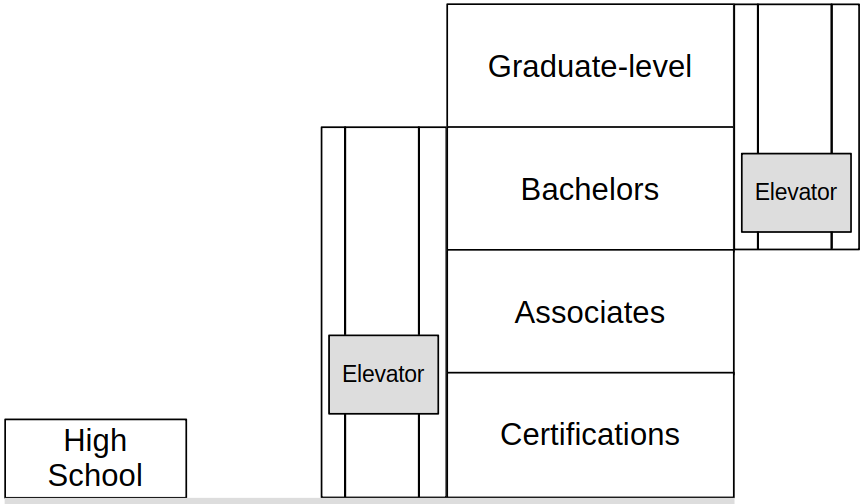
A key point to keep in mind is that the longer you stay here, the more you pay. One of the key conflicts in the formulation of a plan for the degree path is between the risk posed by a hasty decision and the cost of moving slowly. It will be up to you to make a choice that balances these two factors in a way that best satisfies you.
2.1 Associate’s Degrees and Certifications
There are three main purposes for these types of degrees:
1. To prepare you to enter a specific job that requires some training before you are able to start. This usually comes as:
(1) a certification (e.g. to become a dental assistant after 3-4 semesters).
(2) Associate of Applied Science (AAS) degree (e.g. to become a car dealership technician) or an Associated of Applied Arts (AAA) degree.
See this Ivy Tech listing for associates degrees and certifications to see what types of options these degrees can afford you.
-> 2. To provide a low-cost option for students to spend their first two years of a bachelors’ degree.
This is the option that is most relevant to the intended audience of this guide. Depending on your particular institution and field of study, this can be a solid option to reduce the cost of a bachelors degree.
In the Ivy Tech listing above, you will see degrees such as Associate of Science (AS) in Chemisty, Biology, Engineering and even Legal Studies. You will also see Associate of Arts (AA) in Liberal Arts. These are examples of programs that are meant to provide credits that can be transferred from an institution like Ivy Tech to a more traditional university such as Purdue or Indiana University for the purposes of pursuing a bachelors in that field.
3. To provide a low-cost option to acquire some education on a part-time basis.
This might appeal to those who want to switch fields. A popular move was switching to a low-level IT or computer science position before the job market went bust.
2.2 Bachelor’s Degrees
The purpose of a bachelor’s degree is twofold:
1. Provide a holistic education in a wide variety of basic subjects.
This holistic education is similar for everyone in the university, with very little differences between majors. This would include things like basic composition, a speech class, biology, chemistry, college algebra/calculus 1, etc.
Your first 1-2 years of a bachelors degree focuses on these classes, dubbed “general education” classes, with some major-specific classes sprinkled in there.
2. Provide a specialized education in a narrow set of topics.
This is what your major, or even specializations within your major, are about.
Your last 2-3 years almost entirely focus on these classes.
2.3 Graduate Level
Graduate-level degrees come in two flavors:
1. Academic
The purpose of an academic graduate degree is to provide futher specialization in a field and equip the student with the ability to do research work. There are two types of degrees that allow you to focus more on one of these aspects than another:
- Master’s degree
This degree, usually 1-2 years, allows students to further specialize in a particular field within a major. Most master’s programs allow you to choose to specialize with the goal of applying these skills in a professional setting OR with the goal of applying these skills in a research setting. You might be able to become a professor at some community colleges with this degree, although that is changing rapidly.
- Doctor of Philosophy - PhD or DPhil
Acquiring this degree completes your academic track. After this degree, you are an expert in a subject within your field and can perform research autonomously in that field. You need this degree to become a professor at most universities.
2. Professional
Think law and medicine. These are degrees you pursue when you are trying to enter a profession that requires them.
2.4 Mixing and Matching
It is worth pointing out that you can ascend the building however you like. However, you want to move up as quickly as possible, so the ideal navigation pattern is: Associates (optional) -> Bachelors -> Graduate (optional). The question really comes down to whether or not you start at a community college or a university.
1. Associates -> Bachelors -> Graduate (optional)
This allows you to explore different fields of study at a low cost before you end up in a bachelors program.
2. Bachelors -> Graduate (optional)
This allows you to get the full educational experience at a bonafide university, which has its advantages that we will discuss below.
3. Pros
3.1 Professional Aspects
On average, career prospects increase the more degrees you have. Of course, there are outliers, and different degrees have different statistics. Many universities have publicly available data they’ve collected for each major, year, etc. (e.g. this Purdue dataset)
There are 5 outcomes that you can expect to improve by entering a 4-year degree:
- Income
- Networking
- Job security
- Role mobility
- Specialization
3.1.1. Income
Before looking at the data, it is important to understand what determines how much you get paid. Your labor is just the same as any product, its price being determined by supply and demand.
For the purposes of this section, I want you to think of your education as a way to change the types of labor that you can perform. Like a character selection screen in a role-playing game where each character has different stats. Different types of labor have different levels of supply and demand. There are therefore two factors to consider:
3.1.1.a. Demand
Employers want your labor in order to make a profit. The more lucrative your labor, the more they are willing to pay (if forced by supply).
For example, put yourself in the shoes of a McDonald’s owner. You have three different types of employees - crew members, managers, and general managers. Let’s say:
- Each burger makes you \$10.
- You need 10 crew members to operate the store.
- The store sells 100 burgers per hour (all day, every day)
That’s \$1,000/hr that the store generates off of the crew members (who mop the floor, make the burgers, etc.). However, your crew members need materials (lettuce, meat, buns) in order to make those burgers. We add a new bullet point to account for this:
- You can fit enough materials for 4,800 burgers (2 days’ worth) in your store.
That means that you need to coordinate shipments of materials every 2 days. Per math, each shipment has \$48,000 of burgers riding on the managers (who schedule and manage the shipments).
Let’s say that each shipment takes 6 hours to schedule (very generous). Let’s also say half of the profit is from getting the materials to the store (the manager) and the other half is from actually making and selling the burgers (the crew). On a per-hour basis:
- Each crew member makes you \$500/10 = \$50/hr
- Each manager makes you \$24,000/6 = \$4,000/hr
That is a HUGE difference! 80 times in fact!
Now, just because the manager makes 80x the crew’s output, that doesn’t mean they get paid 80x. In fact, the less you pay anyone in this arrangement, the more you make. So why are managers paid more? Because there are fewer people who can do the manager job reliably and effectively than the crew job (mopping versus coordinating shipments).
3.1.1.b. Supply
Employers want to pay you as little as possible. This minimum amount is set by a variety of factors, but today we just want to think about how many other people are available to fill in your position if you leave.
Take the McDonald’s example from the previous point. Let’s say I pay you \$20/hr as a manager, which is what everyone else is paying at the time for managers. Then, something happens to the number of managers and manager positions start being left unfilled (which costs owners \$48,000 per shipment missed!). Because missed shipments cost so much, other managers start increasing the wage they are willing to pay to \$40/hr. If I keep paying you \$20/hr, I risk losing you and not having anyone to fill your place.
On the flip side, if there are tons of people coming up to me looking for management positions, I might offer them \$15/hr and replace you, saving me \$5/hr.
Think about crew members instead. If I’m paying \$15/hr for crew members, and a shortage of workers happens, I can just ride out the shortage because I only lose \$50/hr and crew members are not often out of stock for too long.
3.1.1.c. Data
This is the impact of supply on wages. The more people there are in a job market, the less those people get paid. The more money the position makes for the company, the higher the wage can go before positions start being left unfilled. Keep this in mind as you look at the data below:
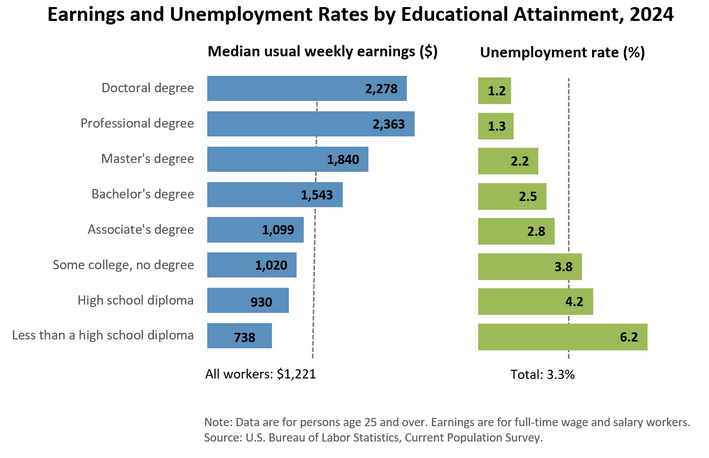
First, an explanation: this figure comes from the US bureau of labor statistics (source). This figure consists of two horizontal bar graphs, where each bar is associated with a different level of education (from highest to lowest going top down) as indicated on the left.
The bar graph on the left represents the median (read here for median vs. mean) weekly earnings with the size of each blue bar for each education group. There is a dotted line down the middle showing the median weekly earnings across all workers.
The bar graph on the right represents the unemployment rate (read here for what that means) with the size of each green bar for each education group. There is a dotted line down the middle showing the unemployment rate across all workers.
Second, let’s interpret this data. As you can see, the general trend is that the more education you have, the more you make and the less unemployment there is. This relates exactly to our discussion of supply and demand earlier - those with more education make more because there is a lower supply of workers that can do those jobs, and less educated people are unemployed because there is a higher demand for those jobs (because they make companies more money).
Let’s focus our attention to the levels of education that we are interested in: high school, associates, and bachelors/masters. In particular I want to see how income increases as we ascend this ladder. Note that all of the below numbers are per week.
-
high school -> associates: $\boxed{+\\$169}$ (= 1,099-930) -> \\$84.5/yr (2 yrs education)
-
associates -> bachelors: $\boxed{+\\$444}$ (= 1,543-1,099) -> \\$222/yr (2 yrs more education)
-
bachelors -> masters: +\$297 (= 1,840-1,543) -> \$148.5/yr or \$297/yr (2 or 1 yrs more education)
As you can see, the income jump between high school and associates is almost 3x less than between associates and bachelors. In light of our previous discussion, this can be understood as there being less demand and more supply of associates because they are easier to obtain (higher supply) and put you in positions less valuable (lower demand) than bachelors.
As a side note, you can see that a masters degree (especially if only 1-year is spent) can achieve comparable-ish income increases. You can only get access to this if you first have a bachelors.
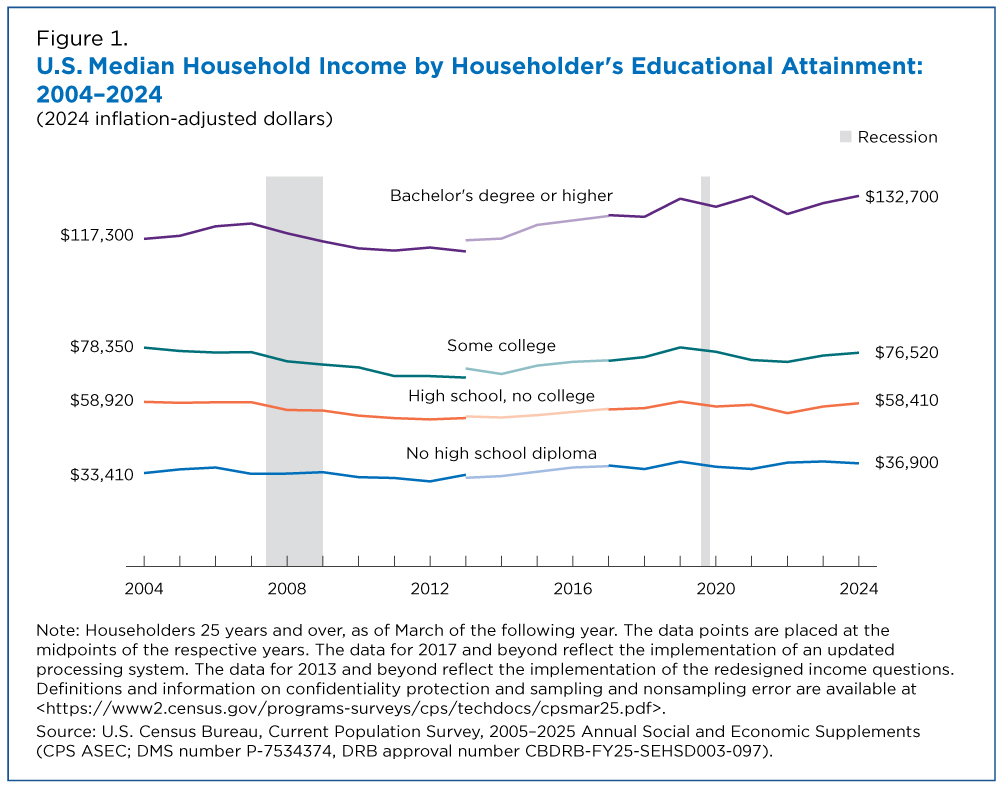
Now, the first figure only gave data for 2024. You will see a lot of alarmism online that degrees are becoming less valuable over time. This is not supported by the data (which is no guarantee of future performance, but there is really no evidence to suggest all degrees are significantly losing their value rapidly…). As you can see in the second figure, these trends have held strong for two decades (and longer). We will discuss the limitations of this data soon and what to be weary of, but buying into extreme alarmism about the economy and education will probably only hurt you (through stress and fear preventing you from living your best life).
3.1.1.d. Data Limitations
The overall message that I want to get out about this data is that it is too broad to base specific decisions on. The WHOLE population of educated people is considered. There can be wide variability across age, locations, degrees, personalities, etc. While the data above are a good indicator to take high education seriously, more data is needed to understand how your preferred situation will fare.
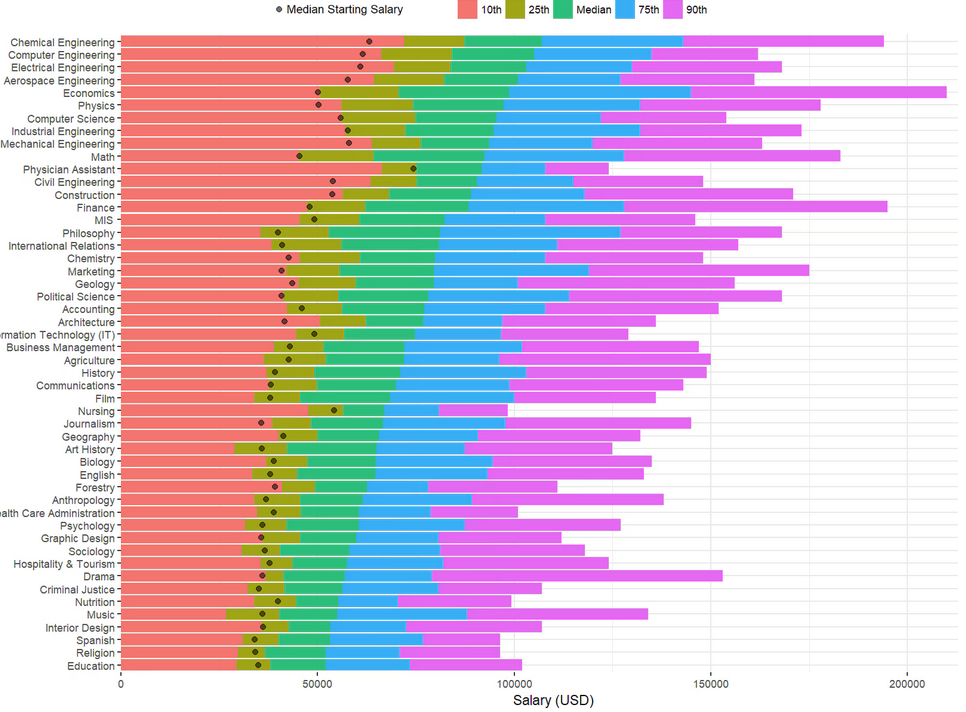
One glaring limitation of the above data is that it lumps ALL degrees from all colleges together into one pile. Various majors may pay less than others (again see the purdue dataset). It is important to look at data for your specific situation when you are considering statistics. (I also really like this figure as a conceptual tool. Mind the data source though)
Another limitation is that all careers, young and old, are lumped together. The longer you stay in a career, the more people you know, the better you are in that field, the more opportunities you’ll have… the older your carer, the further you venture into a low supply, high demand market (see this report for what this looks like for liberal arts students).
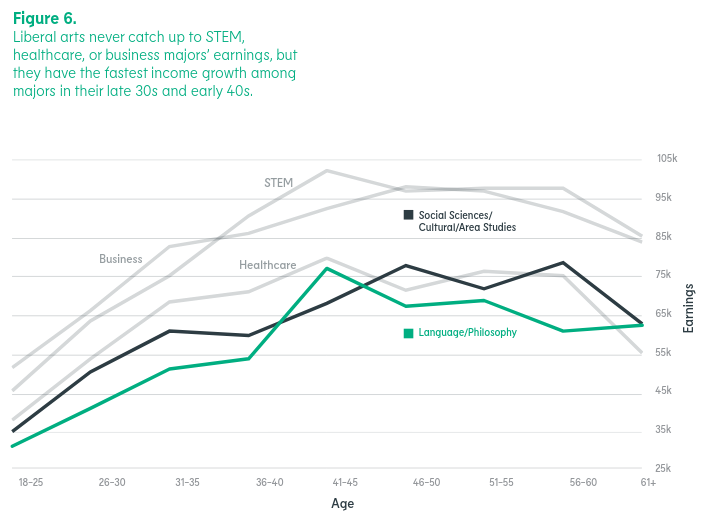
Another limitation is that all locations and colleges are lumped together (see the pattern yet?). Where you study affects literally everything about your education and outcomes. The bad news is that this is such a complex problem that it’s very time consuming to lay out every factor and find an optimal location based on your unique preferences and needs. The good news is that this means worrying about an accurate location and college choice is not worth your time. Becoming comfortable with this level of uncertainty is part of becoming an adult, and there is no shame in making big decisions with a healthy amount of uncertainty about the outcome. There are simple rules of thumb that we will discuss below that can point you in the right direction about this factor. I will link an interesting article on this topic, but I want you to know that this factor is not worth worrying about much (here’s that link).
The last note that I want to leave on is one of caution about drawing conclusions from data. You’ve heard that “correlation does not equal causation,” so just because “line go up” does not alone prove that going to college will make you more money. In order to establish causation, you need a repeatable, strongly correlated, and justifiable mechanism that explains the data. That is the supply and demand concept. So, when you are asking “what is the economically optimal choice?” keep the supply and demand concept and its lessons at the front of your mind. Digging into data is useful, but the concept is really the gold in this exercise.
3.1.2. Networking
“Networking” is the professional equivalent of socializing. There are two alternative conditions that I think define whether or not you are networking:
- Networking can be socializing between professionally related parties.
- Networking can be socializing with a direct professional purpose.
If either of the above conditions is met, you are networking in my book. A useful way to think of networking is the process of building professional connections in a web-like manner:

The name “networking” connects this idea to the idea of a computer network:
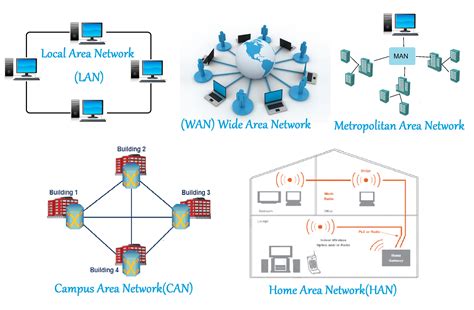
This analogy is incredibly useful. The purpose of a computer network is to transmit information between computers so that every member of the network has the information they need to perform their task. Likewise, the purpose of a professional network is for members to share information and opportunities so that market needs are best fulfilled, usually in the most lucrative possible way for everyone in the profession (depending on the supply and demand for the profession).
The importance of a professional network for the individual professional comes from the fact that a professional network is often the only source of information that you’ll have about new opportunities, developments in your field, etc. Without a network, you lose the skills necessary to be a professional in your field because you lose touch with what even qualifies you as a professional in that field.
Institutions of higher education are a great place to meet other professionals in your field and develop relationships with them. You do homework with them, you work on projects with them, you go to the movies with them, etc. There are very few places like a college campus to build a healthy foundational network for your career.
The alternatives are your place of work - where you compete with other employees for wages - or your competitors - who your business competes for profits with. The advantage of a college for networking lies in the shared experience among the entire population of students, where collaboration only benefits you.
3.1.3. Job Security
We saw the data above to support this, but this is a significant factor that you should consider. Most people would not want to be in a field with high unemployment, even if the jobs were high paying, just due to the stress factor. There is also the opportunity cost of being unemployed out of nowhere - while you’re busy looking for another gig, you could have been working a lower-paying job with higher stability and still making more money in the long run.
3.1.4. Role Mobility
This is actually a very underappreciated aspect of being an educated worker - the ability to switch industries, roles, or even whole professions. This is where the benefits of education in general, covered in 3.2 below, show themselves in the professional world. The fundamental skills you gain through education allow you to tackle many different types of problems. Therefore, you can do many different types of work that have low supply and high demand, and you can always improve through the process of learning. This unlocks so many possibilities and flexibility in your career, especially in comparison to uneducated workers or even trades workers.
If you’re uncertain of where you want your career to go, college is still a great choice due to this factor.
3.1.5. Specialization
We also talked a bit about this above. Specialization is the process of learning so much about a particular subject that you fulfill the needs of markets with an incredibly low supply of what you have. If the subject is also high demand, you can really get paid. It can also be very fulfilling to become great (or even a world expert, if you pursue graduate school) at something.
3.2 Benefits of Education
In this section, I want to talk a little bit about what education brings to you outside of the economic benefits. While school can be challenging and even painful at times, there are immense rewards beyond the monetary benefit.
3.2.1 Getting Better at Learning and Thinking
Learning and thinking are fundamental parts of being human. In fact, you’re doing both right now! It is impossible to escape the onus to learn and think in your day to day life, and is actually quite fun when you embrace it!
Let’s start with an example: planning a wedding. Ideally, a wedding is an occasion that allows you and everyone you care about to celebrate the deep bond you’ve made with your significant other and wish you well on the dangerous legal journey that you’ve embarked on. This is an event that will probably really matter to you (at least the first time around anyways) so you want to get it right.
This is good and all, but in order for this event to be really special, you’ll need a bit more planning than your average barbeque. You cannot plan a wedding without thinking. In fact, planning a wedding is quite a complex problem that will take months.
Furthermore, you are the only person with a large enough stake in the event that has access to the information that will allow you to “get it right.” For one thing, half of the attending party are your guests. For another, what it even means for you to “get it right” requires a good amount of thinking. What kind of time do you want your guests to have? What do you want? What kind of environment, activities, music, etc. will allow both of those things to happen? etc. etc.
The point is, you need to think about these fundamental questions and how they will translate into an actual plan before you can ever offload any work onto someone else. If you do a bad job of this, your special day won’t be so special.
There are many problems like this that are much more fundamental to day-to-day living. “What should I buy?” “How much should I save?” “How much time should I spend at work versus at home?” “Should I take this job?” “Should I eat this?” “Should I trust them?”, all of these are basic questions that stand in between you and what you want. Every. Single. Day.
Therefore, you need to learn how to handle problems like this if you want a shot at happiness.
The kicker is that every college class revolves around learning how to solve problems. With enough time and effort, every one of the above problems becomes as easy as putting your pants on. College turns out to be a really great place to put in the work because you have people all around you dedicated to learning, essentially, how to be happy. You have people in your position who have no clue how to do this, you have all these old people guiding you around and talking to you all of the time about how to do this, and you have to put this into practice every day via homework and time management.
If you’re good at learning and thinking, life becomes easy and you can have a shot at being happy at least some of the time.
3.2.3 Social and Communication Skills
I want you to think about a time you’ve struggled to communicate or fit in with a person or group. In all regrettable situations, it seems like both parties are speaking completely different languages. You say something that’s funny, but they take it the wrong way or don’t find it funny. You tell them something interesting, they find it not interesting at all.
The problem here fundamentally comes down to a lack of social and communication skills. You can get along well with anyone you’d want to get along with if you have the way of expressing what’s in your brain that works for them. You just need to build the ability to understand what way works for the both of you.
There are plenty of opportunities to develop this skill in college.